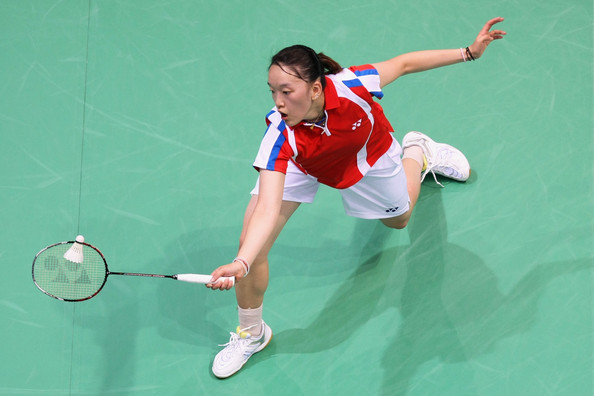
Net play often brings situations where the opponent puts you under pressure with a precise net shot, leaving no option but to hit the shuttle high to the rear court. The forehand lift (or lob) is a crucial defensive and transitional stroke played from the front court area. Its goal is to send the shuttle in a high arc all the way to the opponent's rear boundary line, giving you time to recover your base position and making it difficult for the opponent to mount an immediate attack.
Why the Forehand Lift is So Important
This stroke serves as a reliable safety brake that allows you to:
- Gain precious time: The high trajectory provides enough space for a lightning-fast movement back to the center of the court (re-establishing the ready stance).
- Push the opponent back: A precise lift forces the opponent to retreat from their attacking position at the net all the way to the backline, neutralizing their pressure.
Basic Stance and Preparation
At the net, it is not brute arm strength that decides, but foot speed and swing feel.
- Racket Grip: Use a relaxed basic grip.
- Movement: Approach the net with a swift lunge on your racket foot. The racket extends forward, and the hand is relaxed. The elbow remains slightly bent to give the stroke sufficient space to swing.
Execution Technique Step-by-Step
1. Short Backswing Underneath the Shuttle
The racket head drops slightly below the level of the falling shuttle. The backswing is very short – the arm rotates slightly outward at the forearm (supination) and the wrist opens backward.
2. Hitting Swing and Forearm Pronation
The stroke itself is generated by a lightning-fast straightening of the elbow and a sharp inward rotation of the forearm (pronation), accompanied by a finger squeeze at the exact moment of impact. Hit the shuttle at the highest possible point that the situation allows. The power of the stroke must be precisely controlled to avoid sending the shuttle out past the baseline.
3. Controlled Follow-through
After impact, the racket continues its natural trajectory upward and slightly across the body. However, do not overextend the arm movement – you must immediately snap the racket back in front of your chest into the guard position, as you must be ready for the opponent's reply (e.g., a drop or a clear).
Common Mistakes
- Swinging with the entire arm from the shoulder: Generating power with the whole arm causes you to lose control over the length, resulting in either hitting the shuttle out or playing it too short, allowing the opponent to smash it easily from the mid-court line.
- Hitting too low near the ground: The longer you let the shuttle drop, the harder it is to achieve sufficient height and length, and the more time you give the opponent to prepare their attack.
- Stiff grip on the handle: Squeezing the racket tightly throughout the entire movement completely blocks the delicate snap of the wrist and forearm.
Summary
- The forehand lift rescues the situation from deep defense at the net.
- Hitting power comes from forearm pronation and a quick finger squeeze, not the shoulder.
- The key is to intercept the shuttle early and provide enough depth to the baseline.
- Immediately return the racket up and transition to the ready stance after playing.
Master the forehand lift and never let your opponent trap you at the net.