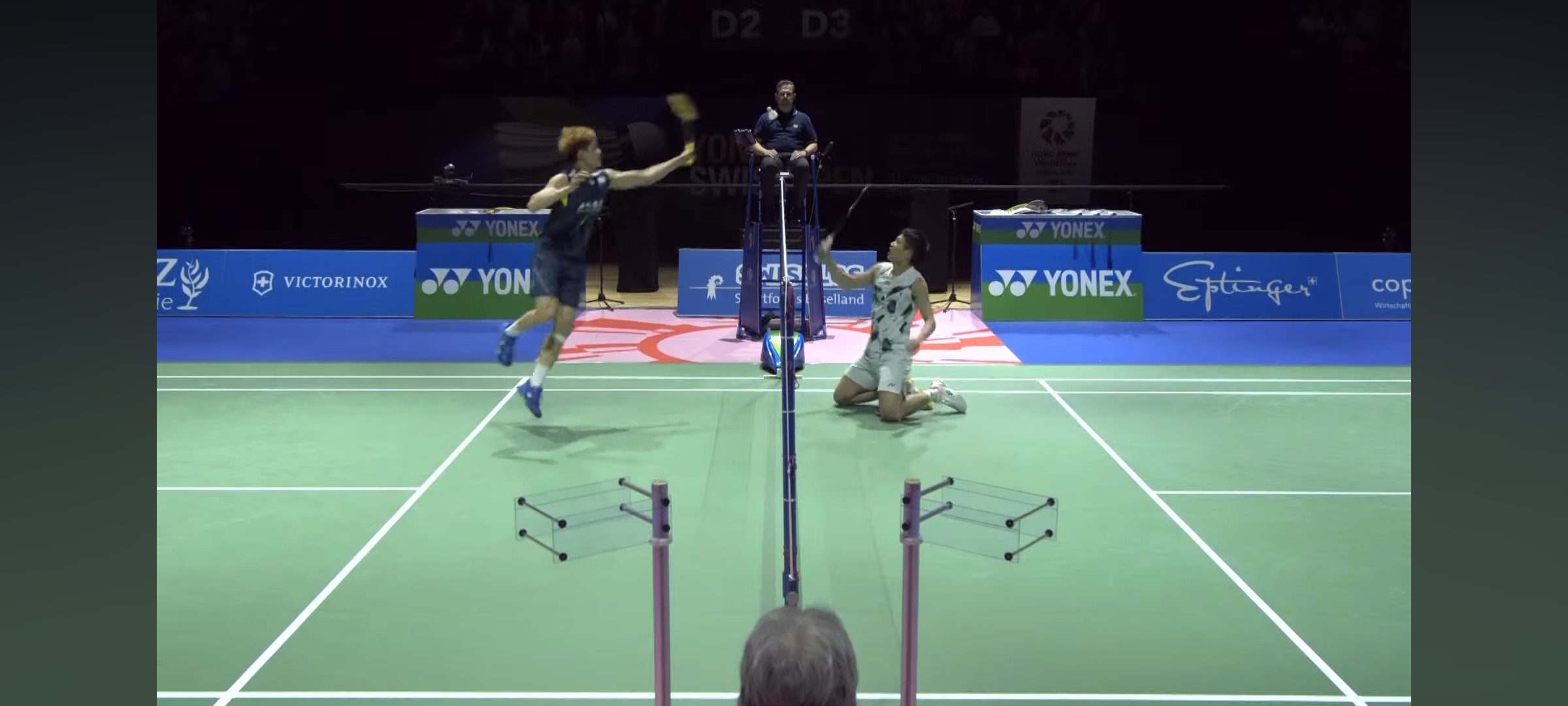
The backhand net kill is the fastest way to turn an opponent's inaccuracy at the net into a winning point. This stroke comes into play the moment you stand close to the net on the backhand side (or in the center) and the opponent returns the shuttle too high above the level of the tape. While the forehand net kill gives the player slightly more natural range, the backhand variation excels with a lightning-fast snap of the wrist and fingers, making it an extremely dangerous weapon.
Why the Backhand Net Kill is So Important
The shuttle travels sharply downwards into the opponent's half after contact. This stroke brings you:
- Absolute dominance at the net: You give the opponent no time to react or defend.
- Body shot opportunities: If you drive or kill the shuttle straight into the opponent, you almost always win the point or force a fatal error.
Basic Stance and Preparation
Speed of execution is key here – fractions of a second matter at the net.
- Racket Grip: For a backhand net kill, it is essential to use the thumb grip. The thumb resting on the wide surface of the handle provides the necessary support for a lightning-fast push of the racket head forward.
- Movement: As soon as you see the opponent's shuttle rising, immediately start forward with the racket raised high above net level and make a quick lunge on the lunging foot.
Execution Technique Step-by-Step
1. Short Backswing
Forget about swinging with the entire arm. The backswing is minimal – bend the elbow and rotate the forearm slightly inward (pronation). The racket points up and is ready right in front of the net.
2. Hitting Swing
The movement comes from a lightning-fast straightening of the elbow and a sharp rotation of the forearm outwards (supination) combined with a squeeze of the thumb and fingers. You must hit the shuttle at the highest possible point.
💡 Important Note: If you intercept the shuttle extremely close to the net, the racket movement must go "over the shuttle" (a short downward wrist snap) to prevent the racket from contacting the net, which would mean losing the point.
3. Follow-through and Immediate Guard
Stop the movement immediately after contact and relax the grip. Do not pull the racket down, but keep it up in front of the body in case the opponent returns the shuttle by a miraculous reflex.
Common Mistakes
- Swinging from the shoulder: Trying to put power into the stroke with the whole arm leads to hitting the shuttle late (low) or hitting the net. Power must come purely from the elbow, forearm, and thumb pressure.
- Net touch: A long racket follow-through forward after the stroke almost always ends with touching the net. The movement must be cut off and directed sharply down along the net.
- Inconsistent racket grip: If you do not use the thumb grip during the kill and leave the racket in a basic grip, you won't have enough power or the right angle to kill the shuttle downwards.
Coach's Tip
When practicing the backhand net kill, shadow training focused on a lightning-fast stop of the racket right after the imaginary hit fits perfectly. During a match, make sure you don't just place the kill into open spaces, but don't be afraid to play straight at the opponent's body – from this position, a backhand shot from the net is practically impossible to retrieve.
Summary
- the backhand net kill is a purely attacking stroke above tape level,
- always use the thumb grip for execution,
- power comes from rapid elbow straightening and forearm supination,
- lead the stroke "over the shuttle" at the net to avoid touching the net.
Master the backhand net kill technique and finish rallies at the net with uncompromising certainty.