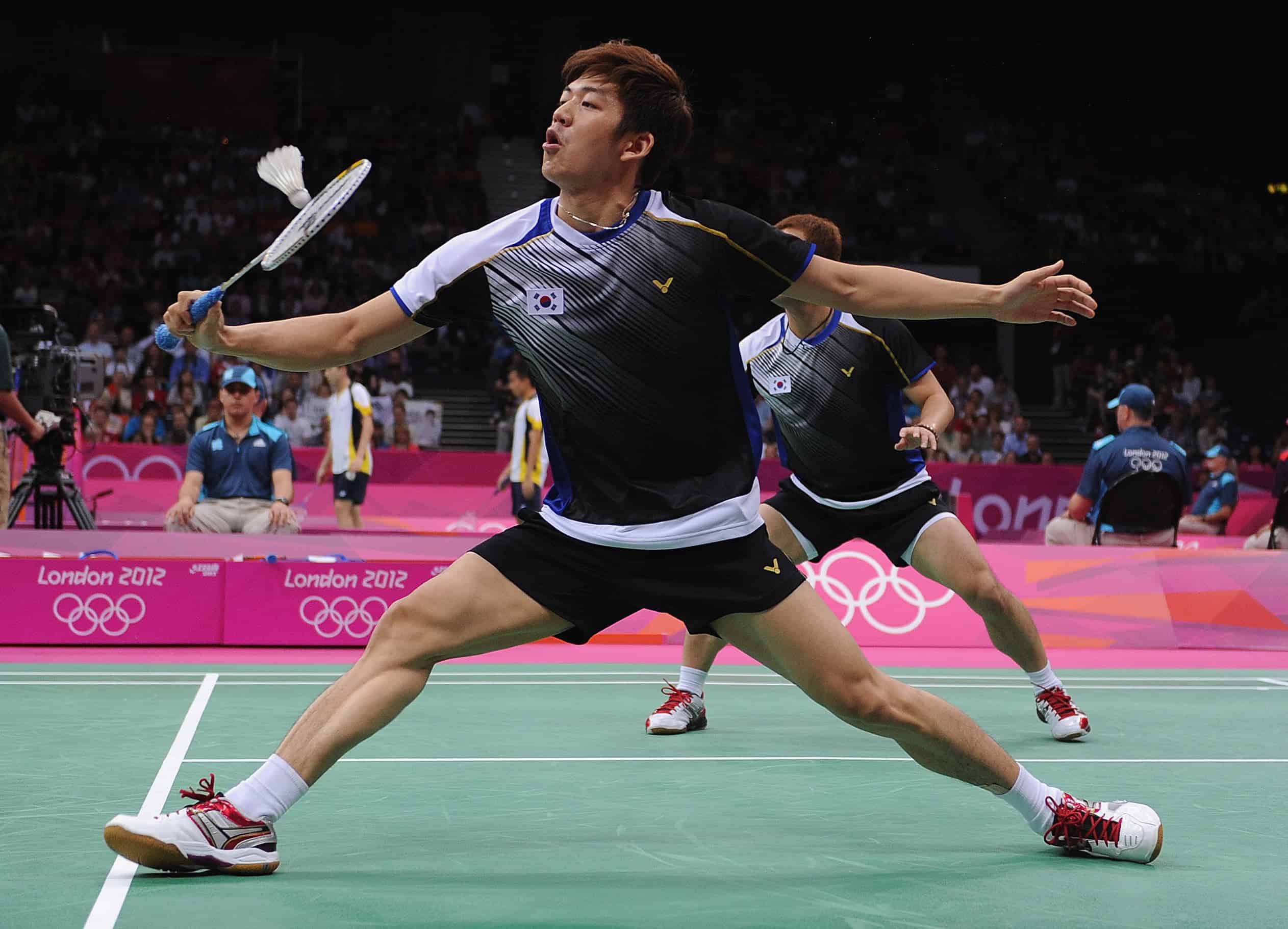
The forehand drive is a flat, fast stroke played from the mid-court area. It is used primarily in neutral situations when the shuttle is traveling too low for you to smash it decisively downwards, but at the same time high enough that you do not need to play a defensive lift upwards. If a player does not master this stroke, they give the opponent an opportunity to attack easily and gain dominance in the middle of the court.
Why the Forehand Drive is So Important
The drive flies just over the net and is directed into the mid or rear court of the opponent. This stroke allows you to:
- Limit the opponent's attacking options: The shuttle flies flat and fast, leaving the opponent no time to prepare an attack.
- Create your own attacking opportunity: If you play the drive into open space or directly at the opponent's body, you often force a weak reply.
Basic Stance and Preparation
Lightning-fast reaction and correct grip are crucial for the drive.
- Racket Grip: If you play the shuttle beside your body, hold the racket in a basic grip. If you have to play the drive quickly directly in front of your body, switch to a panhandle grip.
- Preparation: Have the racket ready in front of your body. At the moment of the opponent's stroke, perform a split-step and make a quick movement or lunge towards the shuttle.
Execution Technique Step-by-Step
1. Backswing
Raise the elbow, which, however, remains slightly bent. Rotate the arm and forearm outwards (forearm supination) and bend the wrist back to get the racket behind the level of the shuttle.
2. Hitting Swing
Straighten the elbow and lightning-fast rotate the arm and forearm inwards (forearm pronation). Hit the shuttle hard and flat in front of or beside the body. If you have little time for the stroke, the angle between the arm and the racket will be larger because you will not have time to execute pronation in its full range.
3. Follow-through and Recovery
After impact, the forearm rotation naturally runs out. You must immediately snap the racket back in front of your body into the ready position using your fingers, as drive exchanges tend to be extremely fast.
Common Mistakes
- Excessive backswing: If you make a large backswing from the shoulder, you will play the stroke late. Power must come from a quick squeeze of the fingers and forearm rotation.
- Lifting the shuttle: If you slice the racket or open its head too much upwards, the shuttle will fly high and the opponent will immediately shoot you down on the mid-line.
- Slow racket recovery: In a drive exchange, you must immediately return the racket up in front of your chest into the ready position after each stroke.
Coach's Tip
You do not always have to play the drive with full power. If you intentionally "soften" the stroke at the moment of impact and relax your fingers, you will play a deceptive drive block just behind the net. An opponent who is already pulling back after your backswing in anticipation of a hard hit will then have no chance to reach the shuttle.
Summary
- The forehand drive is played flat from the mid-court area.
- Alternate between basic and panhandle grip depending on the shuttle position.
- Execute the stroke with a forearm swing, not the entire arm from the shoulder.
- Immediately return the racket in front of your body into the guard position after the stroke.
Master the forehand drive and gain control over the mid-court.