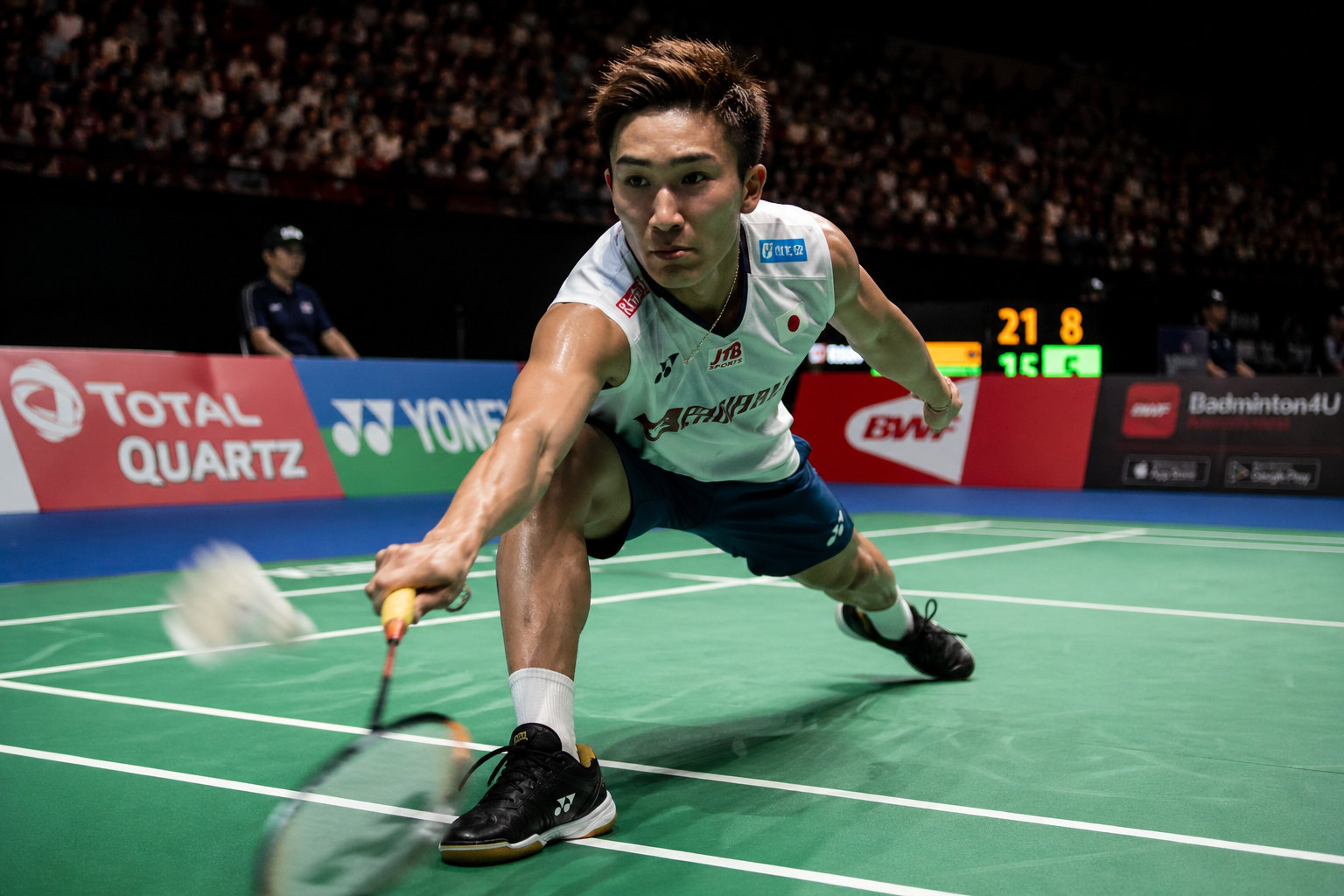
Badminton is one of the fastest sports in the world. Even if you have excellent hitting technique, without effective movement, you won't reach the shuttle in time and in balance. It is footwork that decides whether you or your opponent will dictate the rally.
If a player moves inefficiently, they consume too much energy and reach the shuttle late, leading to forced errors.
Why Proper Footwork is Crucial
The key to success is hitting the shuttle "on time." This means at the highest possible height and as far in front of the body as possible. Proper movement allows you to keep your center of gravity under control and return quickly to the base position.
The Movement Cycle Concept
Modern badminton movement is not just chaotic running. It consists of four logical phases that constantly repeat:
- START (Split-step): Reaction to the opponent's shot. It enables an explosive start toward the shuttle.
- APPROACH: Methods of moving to the shuttle (running steps, chassé, or cross-steps).
- HIT: The actual body movements at the moment of hitting the shuttle, most often ending with a lunge or a jump.
- RECOVERY: Moving back to the ideal position to cover the next shot.
Key Movement Components
1. Split-step
The most important element of the start. It is a small hop you perform at the moment the opponent hits the shuttle. It helps you "unstick" your feet from the ground and immediately launch in any direction.
2. Chassé
A movement where one foot "chases" the other but never quite catches up. This step is ideal for shorter distances and helps keep the head and center of gravity level.
3. Lunge
Most shots in the front and mid-court end with a lunge on the racket foot. A proper lunge must be stable, with the toe and knee pointing toward the shuttle to prevent injury.
Common Mistakes
Missing Split-step
If you stand on flat feet and wait for the opponent to hit, your reaction will always be slow. Without the split-step, you lose precious fractions of a second.
Poor Lunging Technique
If the knee overextends past the toe or points in a different direction than the foot during a lunge, you risk serious ligament injury and loss of stability.
Center of Gravity Too High
Players who move with straight legs are slow and unstable. A slight bend in the knees and lowering the center of gravity is essential for quick changes of direction.
Coach's Tip
Focus on keeping your head level as you move, as if you were floating. If your head "jumps" up and down too much, you waste energy and track the shuttle's path less effectively.
Summary
- The movement cycle has 4 phases: start, approach, hit, and recovery.
- Always perform a split-step at the moment of the opponent's hit.
- Perform lunges with correct technique to protect your joints.
- The goal is to be at the shuttle "on time" and in balance.
Master your movement, and the court will become a much smaller place for you.